


AI in Public Sector Operations: Automating the Mundane, Elevating the Strategic
As part of Government Innovation Week Queensland 2026 in Brisbane, Truis and IBM hosted a roundtable discussion exploring one of the most talked-about topics across the entire event: how public sector organisations can move beyond AI experimentation and begin realising practical, responsible outcomes through AI adoption. The broader event focused on delivering measurable impact through digital transformation, responsible AI, stronger data ecosystems, modern service delivery, and building a future-ready public sector for Queensland.
Facilitated by Kate Eliasen, Public Sector Lead at Truis, alongside Pia Andrews, General Manager, Corporate and Enabling Services at the Department of Children and Families, the roundtable brought together government leaders to discuss where AI is already creating value, where risks remain, and what organisations need to do to ensure successful adoption.
-1.png?width=923&height=396&name=Truis%20x%20IBM%20Roundtable%20-%20GIW%20QLD%202026%20(1)-1.png)
Moving Beyond the Hype: Where AI is Delivering Value Today
A clear theme emerged early in the discussion: AI is exceptionally well suited to repeatable administrative processes. Participants highlighted the potential for AI to automate many of the routine tasks that consume valuable time, allowing employees to focus on higher-value strategic work.
In particular, the ability to convert speech to text was seen as potentially transformative for activities such as case notes, reporting, meeting summaries, and cross-department or inter-agency briefings. Rather than replacing expertise, attendees viewed these capabilities as helping public sector teams redirect effort away from administrative burden and towards citizen outcomes.
The Real Opportunity Lies in Data
The conversation quickly expanded into the importance of data and information management. Many attendees viewed the emergence of referenceable AI-generated outputs as a significant step forward, enabling users to understand where information originated and how conclusions were reached.
One participant compared this evolution to moving from a traditional library system to the Dewey Decimal Classification system, and then ultimately to digital search. Building on the analogy, Pia Andrews suggested an even more fitting metaphor: rather than searching for "a needle in a haystack", AI gives us "a magnet" that can help surface the information we need far more effectively.
The group also discussed the varying quality of data captured across different decades. While many organisations expressed confidence in more recently collected digital data, there was recognition that historical records can often be less complete, less accurate, and more difficult to leverage effectively. This has direct implications for the quality of AI-generated outcomes.
Can AI Write Policy?
One of the more thought-provoking discussions centred on the use of AI for policy development.
Some participants saw enormous potential in AI's ability to accelerate drafting, research and analysis. Others expressed concern around the level of human judgement, context, stakeholder understanding and nuance required to produce robust public policy.
This raised broader questions around quality assurance and validation. How much review is enough? At what point does checking AI-generated content become so time-consuming that it undermines the productivity benefits AI is intended to create? And perhaps most importantly, who is responsible for validating that output?
Protecting Policy in the Age of AI
The conversation around AI and policy development also led to a broader discussion about the role AI should play in shaping future outcomes.
While participants acknowledged AI can be incredibly valuable for policy research, summarisation, drafting support and information discovery, many questioned its suitability as a primary tool for developing policy itself.
A key consideration raised was that policy is designed to define a desired future state. By contrast, AI is trained on existing information, historical records and past decisions. As a result, AI can only provide reflections, patterns and projections based on what has already happened. It cannot inherently understand the social, economic, political or community outcomes that governments may wish to create in the future.
This distinction is important. While AI can help analyse evidence and identify trends, participants agreed that policy development requires human judgement, community engagement, strategic thinking and leadership. These are areas where experience, context, values and vision remain critical.
The discussion reinforced that AI should be viewed as a tool to inform policy development, not replace the policy-making process. Used responsibly, it can help public sector teams work more efficiently and access information more effectively. However, defining the future direction of communities, services and governments will continue to require human decision-making and accountability.
Garbage In, Garbage Out
One phrase surfaced repeatedly throughout the session: "garbage in, garbage out."
Participants agreed that successful outcomes depend on access to quality data, thoughtful prompting techniques, and clear understanding of the limitations of AI models. Examples were shared around bias, differences between models, and the risks associated with treating AI-generated outputs as inherently correct.
The group agreed that data science continues to play a critical role in an AI-enabled future. Rather than reducing the importance of data expertise, AI may actually increase the need for organisations to strengthen their data management, governance and analytical capabilities.

New Technology, New Skills
The discussion also explored how AI is reshaping workforce expectations.
Prompt engineering, AI agent creation and effective AI interaction are rapidly emerging as valuable skills, yet many organisations have not formally defined these capabilities within job descriptions. As a result, employees are increasingly being asked to adopt new behaviours and competencies that simply didn't exist a few years ago.
Participants also reflected on generational differences in AI adoption. Younger workers may be more comfortable experimenting with emerging technologies, while more experienced professionals often hold critical institutional knowledge and decision-making responsibility. The challenge is ensuring these strengths complement one another.
There was also strong agreement that AI cannot replace the deep expertise developed over years or decades of experience. While AI can generate answers quickly, assessing whether those answers are truly correct, contextually appropriate, or optimised for the situation still requires specialist knowledge and judgement.
Governance, Ethics and Public Trust
Perhaps unsurprisingly for a public sector audience, governance and ethics featured heavily throughout the discussion.
Attendees agreed that successful AI deployment cannot be measured solely by technological capability. Guardrails, accountability frameworks and clear governance processes were viewed as essential to safe and responsible adoption.
The tension between capability and ethical practice was also discussed extensively. While AI may offer significant efficiencies, public trust must remain paramount, particularly for agencies responsible for supporting vulnerable or marginalised communities.
Participants emphasised that human connection, empathy, care and professional judgement remain critical components of public service delivery that technology cannot replace.
Understanding What Data We Have
Data maturity and accessibility emerged as another key theme.
While many departments expressed confidence in their governance processes and understanding of where data is stored, there were more varied opinions regarding data accessibility, integration and usability. Questions were raised around how fragmented data environments may limit the ability of AI systems to generate maximum value across agencies and departments.
The discussion reinforced that understanding where data resides, who owns it, who can access it, and how it is governed is becoming increasingly important as organisations seek to scale AI initiatives.
A Transformation on the Scale of Digitalisation
The session concluded with reflections on the scale of change currently underway.
Several participants compared today's AI transformation to the shift from paper-based systems to digital records over previous decades. Real-world examples were shared of government records being permanently lost through floods, fires and other natural disasters, highlighting the vulnerabilities of traditional record-keeping and the importance of modern information management practices.
Like the transition from paper to digital, the shift to AI-enabled operations represents a fundamental change in how government organisations work, manage information and deliver services.
The Conversation Is Just Beginning
Ultimately, the roundtable reinforced a message that was echoed throughout Government Innovation Week Queensland: AI has the potential to significantly improve efficiency, accessibility and service delivery across government, but technology alone is not enough. The future will be shaped by organisations that successfully combine quality data, strong governance, specialist expertise and a people-first approach to innovation.
As many participants acknowledged, the session only scratched the surface of these topics. The opportunities are significant, but so too are the considerations. What was clear from the discussion is that public sector leaders are actively engaging with these challenges and opportunities, and that the conversation around responsible AI in government is only just beginning.
Download the AI Opportunity Assessment Checklist
One of the biggest questions raised during the roundtable was simple: where should organisations start?
While the opportunities for AI seem endless, the most successful initiatives often begin with identifying the right processes to automate, the right data to leverage, and the right governance to support adoption.
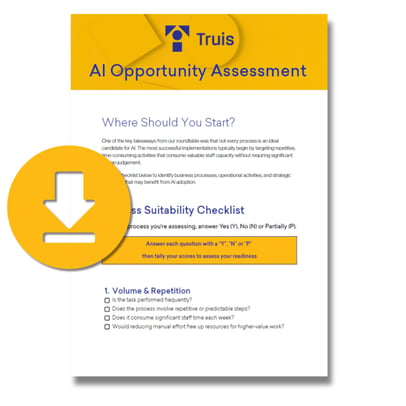
To help government agencies take the next step, we've created an AI Opportunity Assessment Checklist for Government and Public Sector Organisations. This practical resource is designed to help you assess business processes, operational activities, and strategic workloads to identify where AI can deliver the greatest value.
📥 Download the checklist and start identifying opportunities to automate the mundane and elevate the strategic within your organisation.
Ready to discuss your AI roadmap and see how it can help automate your operations?
Book a discovery call with our Truis Public Sector experts.